Microsoft just gave search marketers a clearer look at where AI search reporting is heading.
At SEO Week 2026 in New York City, Krishna Madhavan of Microsoft and Bing previewed new Bing Webmaster Tools features tied to AI search visibility: Citation Share, grounding query intent, grounding query topic labels, and GEO-focused recommendations.
The features appear to expand Bing Webmaster Tools’ AI Performance reporting. They are especially important because they move AI search measurement beyond raw impressions and clicks into something much closer to a real visibility model for generative search.
For SEO teams, this is not just another reporting update. It is a sign that search engines are starting to expose the data layer behind AI-generated answers.
What Microsoft previewed at SEO Week 2026
The preview centered on four additions to Bing Webmaster Tools:
- Intent: a classification of the primary user goal behind a grounding query
- Topic: a semantic topic label that groups related grounding queries
- Citation Share: a percentage showing a site’s share of total citations for a grounding query
- GEO-focused recommendations: actionable recommendations aimed at improving visibility in AI search experiences
Public coverage from Search Engine Land and Search Engine Journal describes the features as previewed or teased, not fully launched for every Bing Webmaster Tools account. That distinction matters. Until Microsoft publishes official release documentation, marketers should treat this as a strong product signal rather than a fully documented feature set.
Even with that caveat, the direction is clear: Bing is building reporting around how websites participate in AI-generated answers.
Why this matters for AI search visibility
Traditional SEO reporting was built around a familiar chain:
- query
- ranking
- impression
- click
- session
- conversion
AI search changes that chain.
When Bing, Copilot, Google AI Overviews, ChatGPT, Perplexity, or another answer engine synthesizes a response, the user may never see a classic list of blue links. Instead, the system retrieves information, summarizes it, cites sources, and often shapes the user’s shortlist inside the answer itself.
That creates a new measurement problem. A brand can be highly visible in AI-generated answers without getting the same volume of traditional organic clicks. Another brand can keep ranking well while losing presence inside the AI answer layer.
This is why metrics like Citation Share matter. They help answer questions that old SEO dashboards struggle with:
- Is our content cited when AI systems answer relevant queries?
- Are we earning a meaningful share of citations or only appearing occasionally?
- Which user intents create AI visibility for us?
- Which semantic topics are we underrepresented in?
- What technical and content issues may block our visibility in generative results?
If rankings tell you where you appear in search results, Citation Share starts to tell you how much of the AI answer ecosystem you occupy.
What is a grounding query in Bing Webmaster Tools?
A grounding query is the query or information need used to ground an AI-generated answer.
In AI search, systems need source material before they can generate reliable responses. They retrieve documents, passages, and data points that help form the answer. Those source-retrieval moments are the foundation for citations.
In practical SEO terms, a grounding query is important because it connects user demand to cited source visibility.
For example, a user may ask:
- “What are the best hiking boots for rain?”
- “Which SEO tools track AI visibility?”
- “How do I improve my brand’s citations in AI search?”
An AI system may use one or more grounding queries to retrieve relevant information before composing the answer. If your page is cited in that answer, Bing Webmaster Tools can potentially report that citation activity.
That is a major shift. Instead of only seeing a query that drove a click, marketers can begin to understand which queries caused their content to be used as supporting evidence.
Citation Share explained
Citation Share appears to show the percentage of total citations a site captures for a specific grounding query.
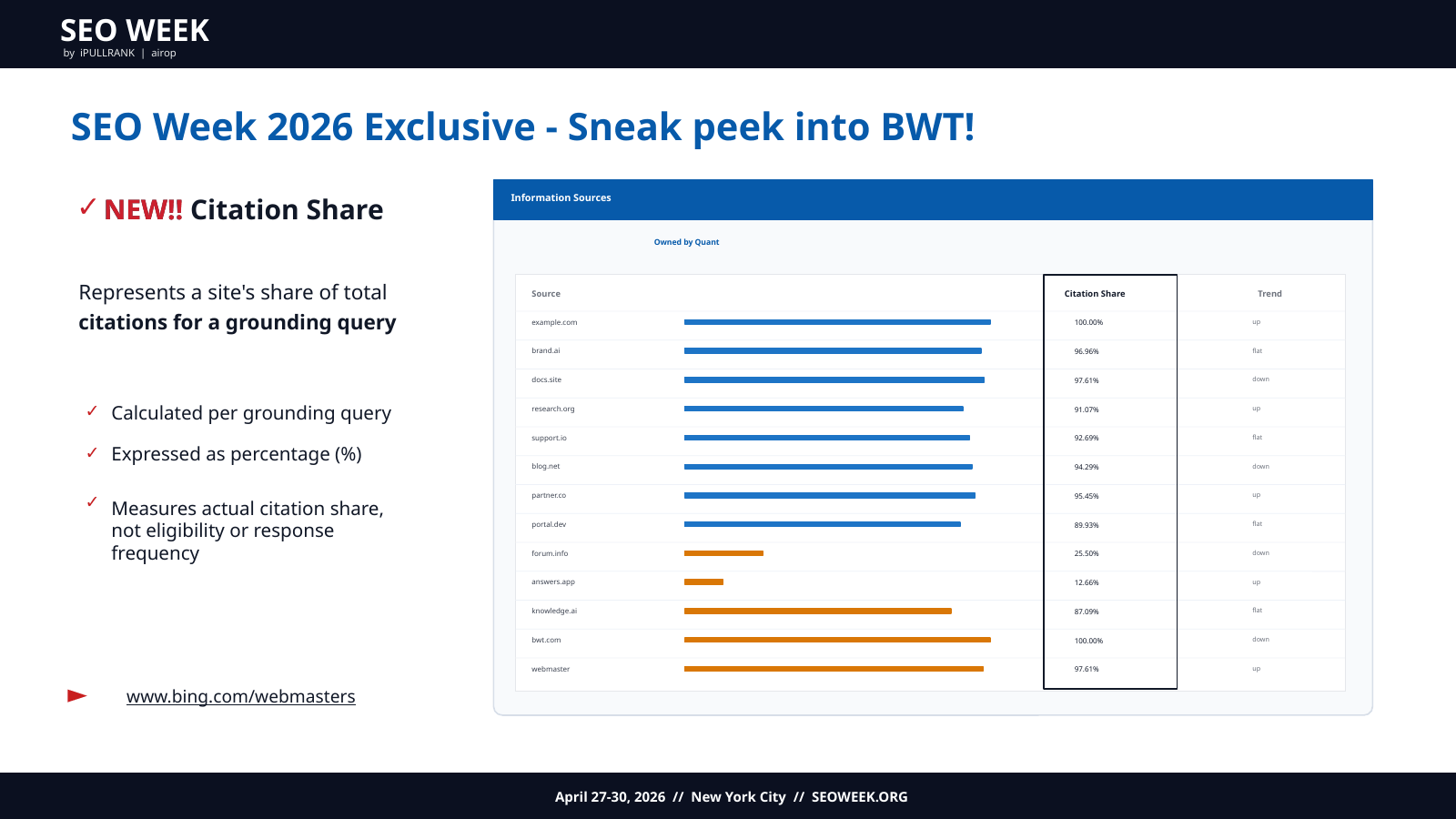
The slide shared from SEO Week describes Citation Share as:
A site’s share of total citations for a grounding query.
It is calculated per grounding query, expressed as a percentage, and designed to measure actual citation share rather than eligibility or response frequency.
That last part is important. Eligibility means your page could be used. Citation Share means your page actually received citation presence in the answer set being measured.
Why Citation Share is different from citation count
A raw citation count is useful, but it lacks competitive context.
Imagine two grounding queries:
| Grounding query | Your citations | Total citations | Your Citation Share |
|---|---|---|---|
| best AI visibility tools | 12 | 20 | 60% |
| how to monitor brand mentions in ChatGPT | 12 | 80 | 15% |
Both queries produced 12 citations for your site. But the strategic meaning is completely different.
In the first query, you dominate the citation set. In the second, you are only one source among many.
Citation Share turns citation reporting into a market-share-style metric for AI search.
What Citation Share can reveal
Once available, Citation Share could help SEO and GEO teams identify:
- topics where a brand is the dominant cited source
- queries where competitors are taking most of the answer space
- pages that earn citations but fail to capture a strong share
- content clusters that need more authority, clarity, or supporting assets
- query types where third-party sources carry more influence than owned content
This is the kind of reporting AI search teams have needed. It moves the conversation from “Did we get cited?” to “How much of the answer layer do we own?”
Grounding query intent: the user goal behind the AI answer
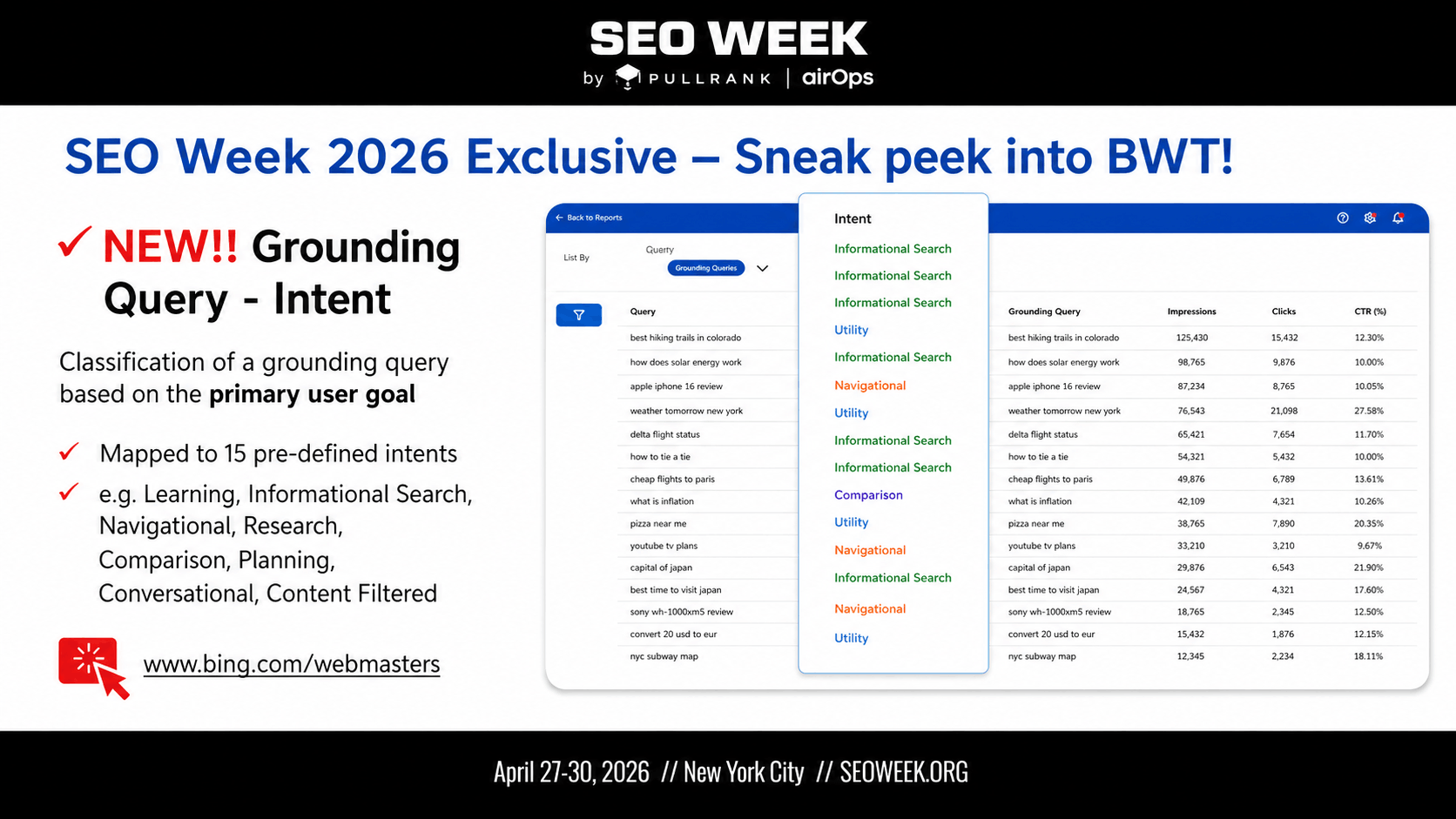
Microsoft also previewed intent labeling for grounding queries.
The slide describes intent as classification of a grounding query based on the primary user goal. The preview references 15 predefined intents, with visible examples including:
- Learning
- Informational Search
- Navigational
- Research
- Comparison
- Planning
- Conversational
- Content Filtered
This matters because AI search queries are often longer, more specific, and more task-oriented than traditional keyword searches.
A classic SEO dashboard might show a list of individual queries. But when users ask natural-language questions, the query list can become noisy very quickly.
Intent labels can make that data usable.
Why intent labels are useful for SEO teams
Intent classification helps teams understand whether AI visibility is happening in the right moments.
For example, a B2B SaaS company may find that it earns citations for informational queries but is absent from comparison queries. That would suggest the brand is visible for education but weak in purchase consideration.
An ecommerce brand may find the opposite: strong visibility for product-specific navigational queries but poor visibility for early research and planning queries.
Intent labels could help teams separate:
- educational visibility from buying visibility
- brand demand from category demand
- comparison opportunities from low-intent traffic
- planning-stage questions from direct navigation
- research behavior from transactional consideration
That is much more useful than treating every AI citation as equal.
Topic labels: semantic grouping for messy query data
The Topic feature appears to group similar grounding queries under a common semantic label.
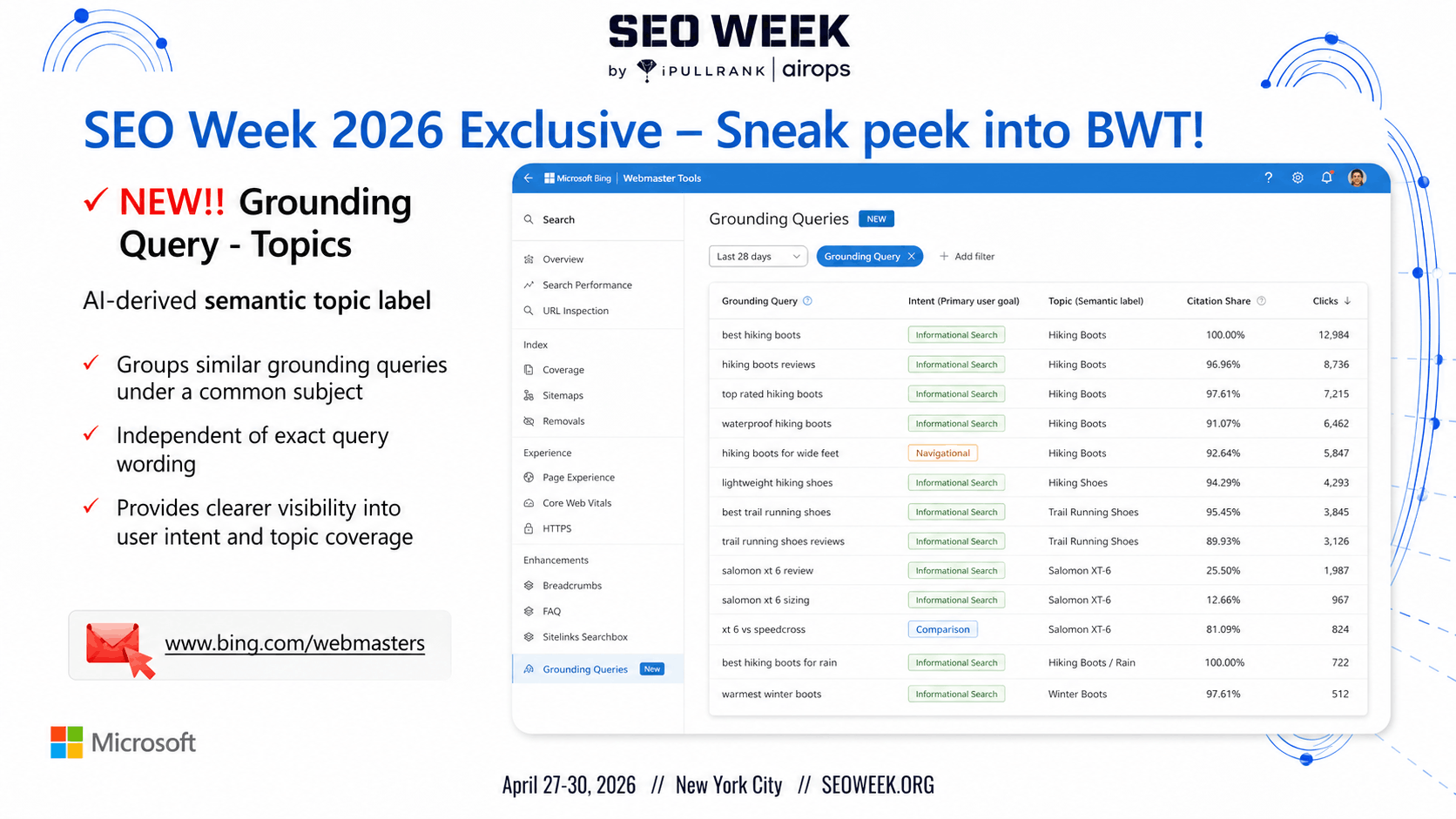
In the SEO Week preview, examples include topics such as hiking boots, hiking shoes, trail running shoes, and specific product or subcategory labels.
This is exactly the kind of grouping AI search reporting needs.
Traditional keyword reporting often fragments semantically similar queries:
- “best hiking boots”
- “top rated hiking boots”
- “waterproof hiking boots”
- “hiking boots for wide feet”
- “best hiking boots for rain”
Those are different phrases, but they all live inside a broader topic cluster.
Topic labels can help marketers see coverage patterns across the cluster instead of overreacting to individual query wording.
Why topic labels matter for GEO
Generative Engine Optimization is not only about optimizing one page for one keyword. It is about making a brand, product, or source reliably understandable across a topic space.
Topic labels can reveal whether your content is strong across an entire semantic area or only visible for isolated phrases.
For example, an AI visibility platform might want to measure topics like:
- AI search visibility
- AI citation tracking
- brand mentions in ChatGPT
- LLM recommendation monitoring
- generative engine optimization
- AI Overviews reporting
If one topic has high Citation Share and another has almost none, that becomes a content and authority roadmap.
This is why topic-level reporting may become one of the most useful parts of Bing Webmaster Tools for content strategists.
GEO-focused recommendations: SEO basics meet AI visibility
The fourth previewed feature is GEO-focused recommendations.
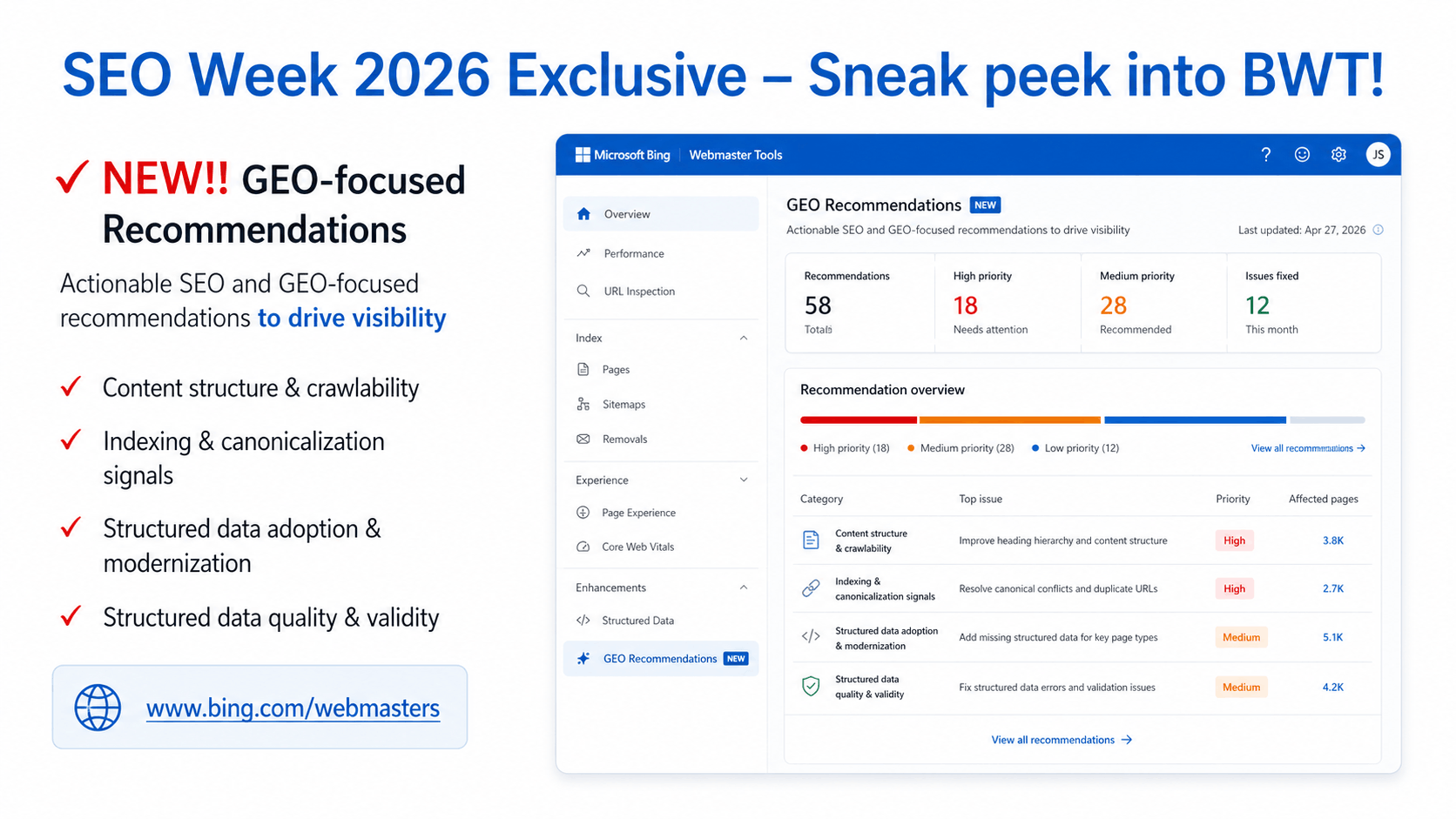
The slide describes these as actionable SEO and GEO-focused recommendations to drive visibility. Visible recommendation areas include:
- content structure and crawlability
- indexing and canonicalization signals
- structured data adoption and modernization
- structured data quality and validity
At first glance, these look like familiar technical SEO categories. That is the point.
AI search visibility still depends on whether search systems can crawl, understand, trust, and cite your content. The interface is changing, but the underlying discovery and extraction problems still depend heavily on classic SEO foundations.
What GEO recommendations may mean in practice
Until Microsoft documents the recommendation logic, we should avoid assuming exactly how these recommendations are generated.
But the preview suggests Bing may connect AI visibility issues to practical site improvements such as:
- improving heading hierarchy
- resolving duplicate URL and canonical conflicts
- adding missing structured data for important page types
- fixing structured data validation issues
- improving crawlability for important content
- making key answers easier for retrieval systems to extract
That is important because many teams treat GEO as something completely separate from SEO. In reality, GEO often depends on strong SEO fundamentals plus better answer formatting, entity clarity, and citation-worthy content.
How this changes the SEO reporting stack
If Bing rolls these features out broadly, SEO teams will need to rethink their dashboards.
The old stack focused on:
- rankings
- impressions
- clicks
- click-through rate
- organic sessions
- conversions
The emerging AI search stack adds:
- citation presence
- Citation Share
- citation source overlap
- grounding query coverage
- intent coverage
- topic coverage
- AI answer framing
- recommendation and shortlist presence
This does not replace traditional SEO reporting. It extends it.
Organic clicks still matter. Rankings still matter. Technical SEO still matters. But they no longer tell the whole story when AI-generated answers can influence the user before the click.
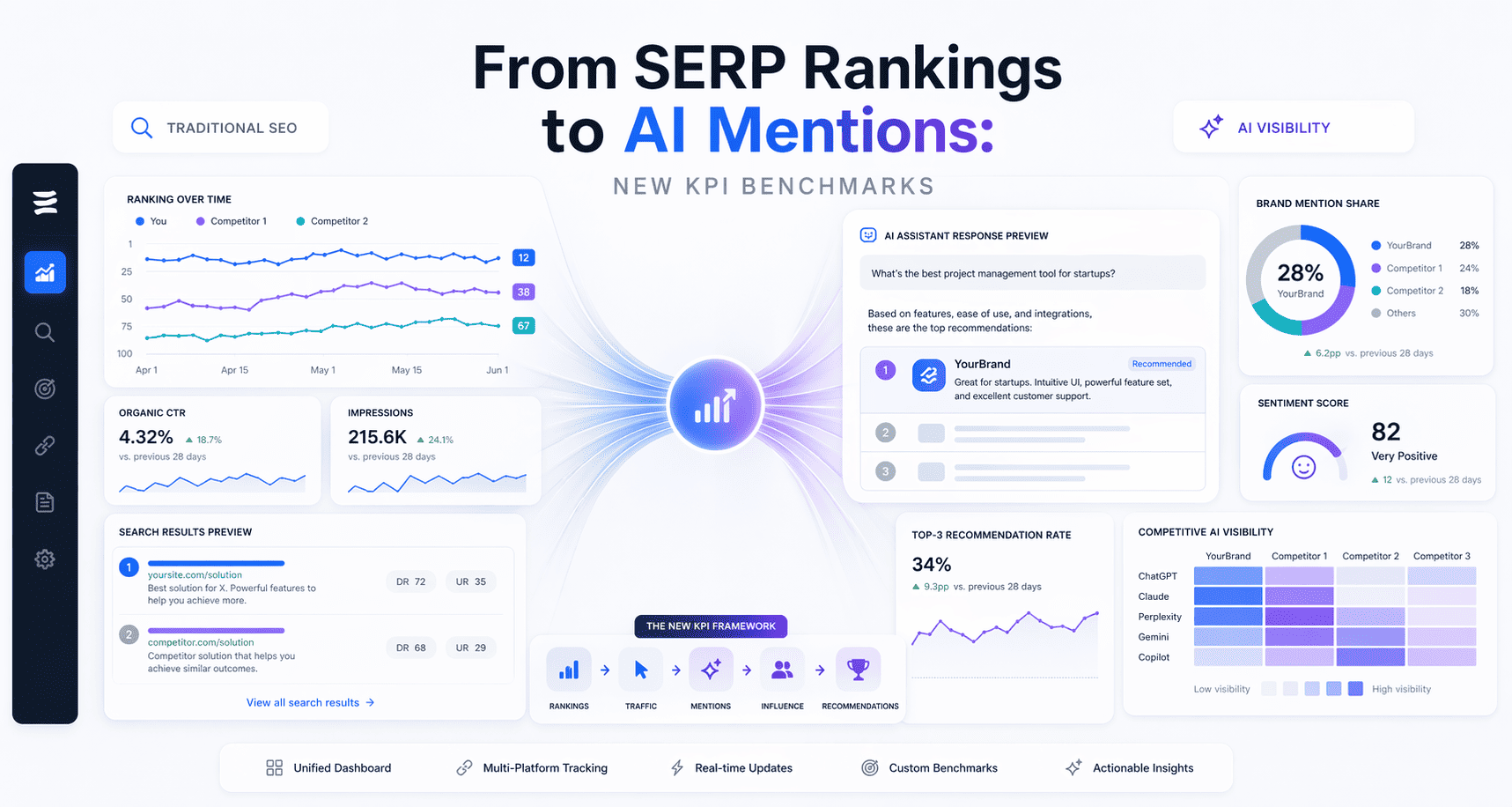
That is why we have argued that teams need to move from pure SERP reporting to AI mention and visibility benchmarks. Bing’s preview is another sign that the industry is moving in that direction.
What brands should do now
The features may not be broadly live yet, but teams can prepare immediately.
1. Build your grounding query universe
Start by listing the questions that matter in your category.
Group them by:
- category discovery
- product alternatives
- feature research
- problem-aware searches
- comparison queries
- industry-specific needs
- buyer persona questions
Do not only track one head term. AI search behavior is broad, conversational, and context-specific.
2. Map queries to intent
Before Bing gives you official intent labels, create your own working taxonomy.
For each target query, label whether it is informational, research-driven, comparison-oriented, navigational, planning-based, or purchase-adjacent.
This will help you understand whether your content is visible at the right stages of the buying journey.
3. Group prompts and queries by topic
Build semantic clusters instead of flat keyword lists.
For example, a brand in AI visibility might group queries into:
- AI visibility monitoring
- LLM citation tracking
- ChatGPT brand mentions
- AI Overviews optimization
- GEO strategy
- competitor visibility in AI answers
Then evaluate whether you have strong content, third-party mentions, and clear entity signals for each cluster.
4. Rewrite priority pages for extraction
AI systems need clear, extractable passages.
Priority pages should answer important questions directly near the top, use descriptive headings, include comparison language where relevant, and make brand positioning explicit.
This is especially important for pages that target category, comparison, and buyer-intent queries.
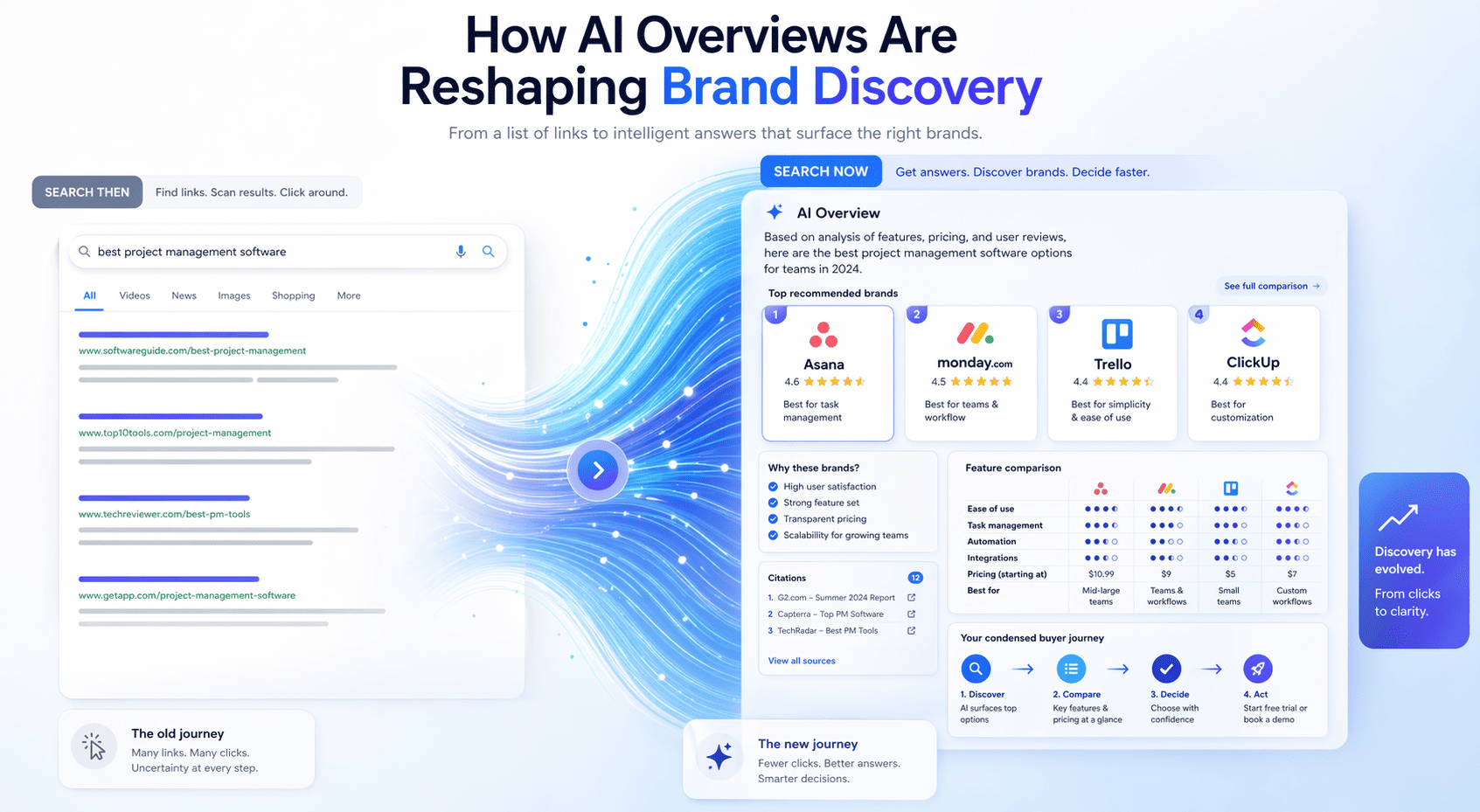
For more context on why this matters, read our guide on how AI Overviews are reshaping brand discovery.
5. Strengthen structured data and technical SEO
The GEO recommendations preview strongly suggests that technical SEO remains part of AI visibility.
Make sure important pages are crawlable, canonicalized correctly, internally linked, and supported by valid structured data where appropriate.
That will not guarantee AI citations, but weak technical foundations can make citation visibility harder to earn and harder to diagnose.
6. Track AI visibility outside Bing too
Bing is offering valuable transparency, but buyers do not only use Bing or Copilot.
Teams should also monitor visibility across systems such as ChatGPT, Claude, Gemini, Perplexity, and Google AI Overviews where possible.
That is where an independent AI visibility reporting workflow becomes useful. Bing Webmaster Tools can show how Bing sees your site. A broader monitoring stack can show how the market’s answer engines describe and cite your brand across platforms.
A practical Citation Share workflow
When Citation Share becomes available, do not treat it as a vanity metric. Use it as a prioritization tool.
Start with this workflow:
| Step | Question to answer | Action |
|---|---|---|
| 1 | Which grounding queries cite us? | Identify existing AI visibility |
| 2 | Which queries have low Citation Share? | Find competitive gaps |
| 3 | Which topics have weak share? | Prioritize content clusters |
| 4 | Which intents underperform? | Fix journey-stage gaps |
| 5 | Which pages are cited most? | Improve and expand winning assets |
| 6 | Which pages should be cited but are absent? | Improve content, internal links, schema, and external authority |
The goal is not only to increase citations. The goal is to increase meaningful citation share for the queries and topics that influence your market.
What this means for GEO strategy
This preview is a strong validation of GEO as an operating discipline.
For the past year, many teams have debated whether Generative Engine Optimization is real, whether it is just SEO with a new name, or whether it requires an entirely different workflow.
The answer is becoming clearer.
GEO is not a replacement for SEO. It is the extension of SEO into AI-mediated discovery.
That means teams need to optimize for:
- being crawled
- being understood
- being cited
- being described accurately
- being included in answer shortlists
- being associated with the right topics and use cases
- being reinforced by credible third-party sources
Microsoft’s previewed features map directly to those needs.
Intent tells you why users are searching. Topic tells you what semantic space the query belongs to. Citation Share tells you how much of the cited answer layer you occupy. GEO recommendations point toward actions that may improve visibility.
That is a much more mature model than simply counting rankings.
Common mistakes to avoid
Mistake 1: Treating Citation Share like rank tracking
Citation Share is not the same as ranking position. It is closer to share of cited evidence for a grounding query.
That means you should compare it across topics, intents, competitors, and page types rather than reading it like a classic SERP rank.
Mistake 2: Optimizing only for your homepage
AI systems often cite specific pages, not just brands.
Your homepage may define the company, but category pages, product pages, documentation, comparison pages, research posts, and third-party profiles can all influence AI answer visibility.
Mistake 3: Ignoring third-party sources
If AI systems rely on review sites, directories, publisher articles, community discussions, and partner pages, your owned site is only part of the answer.
You need consistent brand information across the web.
Mistake 4: Confusing visibility with positive framing
Being cited is good. Being cited with the right positioning is better.
Track whether AI systems describe your brand accurately, recommend it for the right use cases, and compare it fairly against competitors.
Mistake 5: Waiting until the tools are perfect
AI search reporting is still early. If you wait for perfect analytics, competitors will learn faster.
Start with a fixed set of prompts and topics now. Use Bing’s new reporting when it becomes available, but do not wait to build your own visibility baseline.
FAQ: Bing Webmaster Tools Citation Share and GEO reporting
What is Bing Webmaster Tools Citation Share?
Citation Share is a previewed Bing Webmaster Tools metric that represents a site’s share of total citations for a specific grounding query. It appears to be expressed as a percentage and focused on actual citations, not just eligibility to appear.
Is Citation Share live in Bing Webmaster Tools?
Public reporting describes Citation Share as previewed at SEO Week 2026. Microsoft has not yet published detailed official release documentation for broad availability, so teams should treat it as an upcoming or limited-preview feature until confirmed by Microsoft.
What is grounding query intent?
Grounding query intent is a label for the primary user goal behind a grounding query. The SEO Week preview referenced predefined intent categories such as informational search, navigational, research, comparison, planning, learning, conversational, and content filtered.
What is a grounding query topic?
A grounding query topic is a semantic label that groups similar grounding queries under a common subject. This helps marketers analyze AI visibility at the topic level rather than relying only on exact query wording.
What are GEO-focused recommendations?
GEO-focused recommendations are previewed Bing Webmaster Tools recommendations intended to improve visibility in generative search experiences. The preview showed categories such as content structure, crawlability, indexing, canonicalization, structured data adoption, and structured data quality.
How should SEO teams use Citation Share?
SEO teams should use Citation Share to identify which grounding queries and topics they dominate, where competitors are earning most citations, and which content clusters need improvement. It should be paired with intent, topic, page, and competitor analysis.
Does this replace traditional SEO reporting?
No. Citation Share and AI visibility metrics extend traditional SEO reporting. Rankings, impressions, clicks, crawlability, and structured data still matter, but AI search adds another layer: whether your content is cited and how much of the answer space your brand occupies.
The bottom line
Bing Webmaster Tools’ previewed Citation Share, intent labels, topic labels, and GEO-focused recommendations are a major signal for the future of SEO reporting.
Search visibility is no longer only about where a page ranks. It is also about whether AI systems use your content as evidence, how often they cite you, which topics they associate you with, and whether your brand appears in the answers that shape user decisions.
For SEO teams, the next move is clear: build a measurement system around AI visibility now.
Track your prompts. Group them by intent and topic. Measure mentions and citations. Improve pages for extraction. Strengthen technical SEO. Watch how AI systems frame your brand.
The search interface is changing, but the strategic goal is the same: become one of the sources users and search systems trust when it is time to answer the question.
If you want to understand how your brand appears across AI search surfaces, start with PromptMention’s AI visibility tools and build your baseline before the reporting gap widens.